Compass & Square
Perhaps
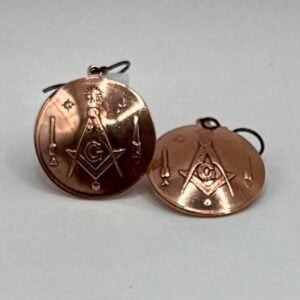
the best-known of all Masonic symbols are the compass and
square, shown interlocked with the letter "G" between
them, as the traditional emblems of Freemasonry. During the
granting of the First, Second and Third Degrees, the compass
and square are placed upon the altar of the Temple
in an interlinked fashion, representing the divine Light as
it unites with the candidate and fills him with increasing
knowledge. At the same time, this leads to his "rebirth" as
its resurrected "offspring".
That this symbolic rite was derived from a still older mystery,
however, is suggested by an early Masonic catechism, which
asks,
What
did the 2 cherubim on the ark of the covenant represent?
The
answer which it gives is: "The
mystery of the Golden Altar" (Dumfries Ms., ca. 1799).
Thus,
the union of "the two Cherubim" in the Jerusalem
Temple would appear to be the ultimate source of the "mystery
of the Golden Altar" in the Masonic Temple.
The
letter "G" (signifying
God's secret Name) appears between the intertwining
compass and square
and is paralleled by Philo's explanation that the union of
the statues in the Jewish Temple represented God's "consorting" with
the soul, and his "divinizing" of the recipient.
Thus the compass and square are exact symbolic equivalents
of the ancient Cherubim, i.e. the ancient "Male" and "Female," whose
union was the central feature of the Wisdom mystery, and which
brought about the candidate's deification. But we should
also compare this unique symbolism with the Divine Image itself
(Gen. 1:27), which teaches that God is male and female united;
hence the sacred "G" appears only when the male compass
and the female square are intertwined.
The
association of these "male" and "female" symbols
with solar and lunar iconography was also based
on early Israelite and Semitic tradition, according to which
the heavenly bodies represented various male and female deities.
Their symbols were in fact still used by European alchemists
to describe the union of "heaven" and "earth," taking
the "Sun" as a figure of Christ, and the "Moon" as
a figure of his Bride, the Church. These must again unite in
order to "beget" the "Philosopher's Stone," i.e.
eternal life.
Above,
the celestial things, below, the terrestrial; by the male
and the female the work is accomplished. Join the male
and the female and you will find what you are seeking (Aphorisms
of Zosimus)
But
before they can complete this all-important work, both must
die and pass through the "nigredo" state,
i.e. the death and dissolution of the body. Zosimus
appropriately characterized this stage of the mystery with
the image of the "priest" who is torn to pieces and
mutilated before he can be resurrected and discover the "Stone
of the Nile."
Other
alchemists described the marriage of the "sun-compass" and
the "moon-square" as the bringing together of superius/inferius
and externis/interius, which exactly
mirrors the language of the ancient Gospel of Thomas ("You
shall enter the Kingdom when the upper is as the lower and
the outside is as the inside.") Both "Male" and "Female" will
then be resurrected as the "gold" of eternal life,
forever joined as a divine zakar wanekebah, or "Rebis" ("Two-in-One").
The "Sun" and the "Moon" are further
referred to as the "King" and "Queen," just
as the Jews referred to God and his exiled Shekhinah in the
Kabbalistic mystery.
The
ultimate origin of the compass and square as divine emblems
is presently lost
in the mists of antiquity, but their universal
employment as builders' tools caused them to appear nearly
everywhere as theological symbols for denoting creative power.
In Greek iconography, for example, the nature of the gods Pluto,
Bacchus and Mars was represented by the triangle (a three-sided,
enclosed compass), and that of the goddesses Rhea, Venus, Ceres,
Vesta and Juno by the square. In Egypt, the "amulets" of
Osiris included two plumb lines, suspended from two compasses,
as well as two squares. In pre-Christian China,
one also found the Demiurge, Fu Hsih, and his female counterpart,
Nü Kua, displaying the compass and square as symbols of
their male and female creative powers. Even earlier, the I
Ching (ca. 720-474 B.C.) had described the heavens as round
(just as the compass delineates the horizon),
and the earth as square (with its "four corners").
But
these symbols were also employed by the Israelite Creator,
who declares in the Old Testament, "I
will set a plumb line in the midst of my people, Israel" (Amos
7:8). . . "Judgment will I lay to the line, and righteousness
to the plummet" (Isa. 28:17). . ."And thou shalt
make an altar...(that) shall be foursquare" (Ex. 27:1). . .
"When
he prepared the heavens, I was there; when he set a compass
upon the face of the depth." (Prov. 8:27) . . . "He
has described a circle upon the face of the waters" (Job 26:10)
These
references show that the ubiquitous builder's tools were
also traditionally associated with his divine power and
work. There was a legend that the veil before God's Throne
in the Heavenly Holy of Holies was covered with the archetypal
forms from which Creation would proceed. These forms undoubtedly
included the basic round and straight shapes of nature, which
the compass and square were used to mark out. It is therefore
no surprise to find that medieval cathedral builders frequently
depicted Christ with the plumb line, compass and square in
his hands, as, for example, in the Cathedral of Santa Croce
in Florence, where Jesus stands above the main portal holding
the worker's square as a sign of his divine creative power.
http://www.shields-research.org/General/Masonry.html
Alchemical
Symbols Gallery | Back | Next